



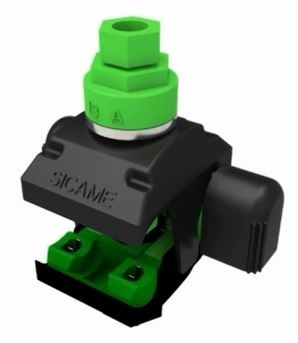
New range of insulation piercing clamps
TTD neo terminals are the answer to the question of how to reduce losses, a question that affects almost every aspect of our lives today. In this case, it concerns losses occurring in energy distribution networks.
It only seems that resistivity measured in μΩ is irrelevant and that the current flowing through a terminal does not cause significant power losses. If a single terminal is treated as a small heater carrying a current of 100 A and its resistivity is 150 μΩ, the power of this “heater” would be 1.5 W. Not much? Yes, for a single terminal. But a lot when we consider the terminal’s uninterrupted operation over a typical 30-year period for this type of product. From the perspective of an energy distributor managing the network, there’s also the issue of the number of terminals within its operating area. These are quantifiable losses.
That’s why SICAME has implemented low-resistance copper blade technology in the TTD neo. This technology is reinforced by the use of high-quality plastics that ensure good contact pressure. This allows for a reduction in resistivity to 35 μΩ for the TTD151neo terminal, which is popular among customers due to its range of wire cross-sections, and even 25 μΩ for terminals designed for larger wire cross-sections, such as the TTD301neo. Comparing the TTD neo resistivity to even a terminal with a 100 μΩ resistivity, such as that used by distributor X, demonstrates the scale of the potential loss reduction. These are measurable savings.